
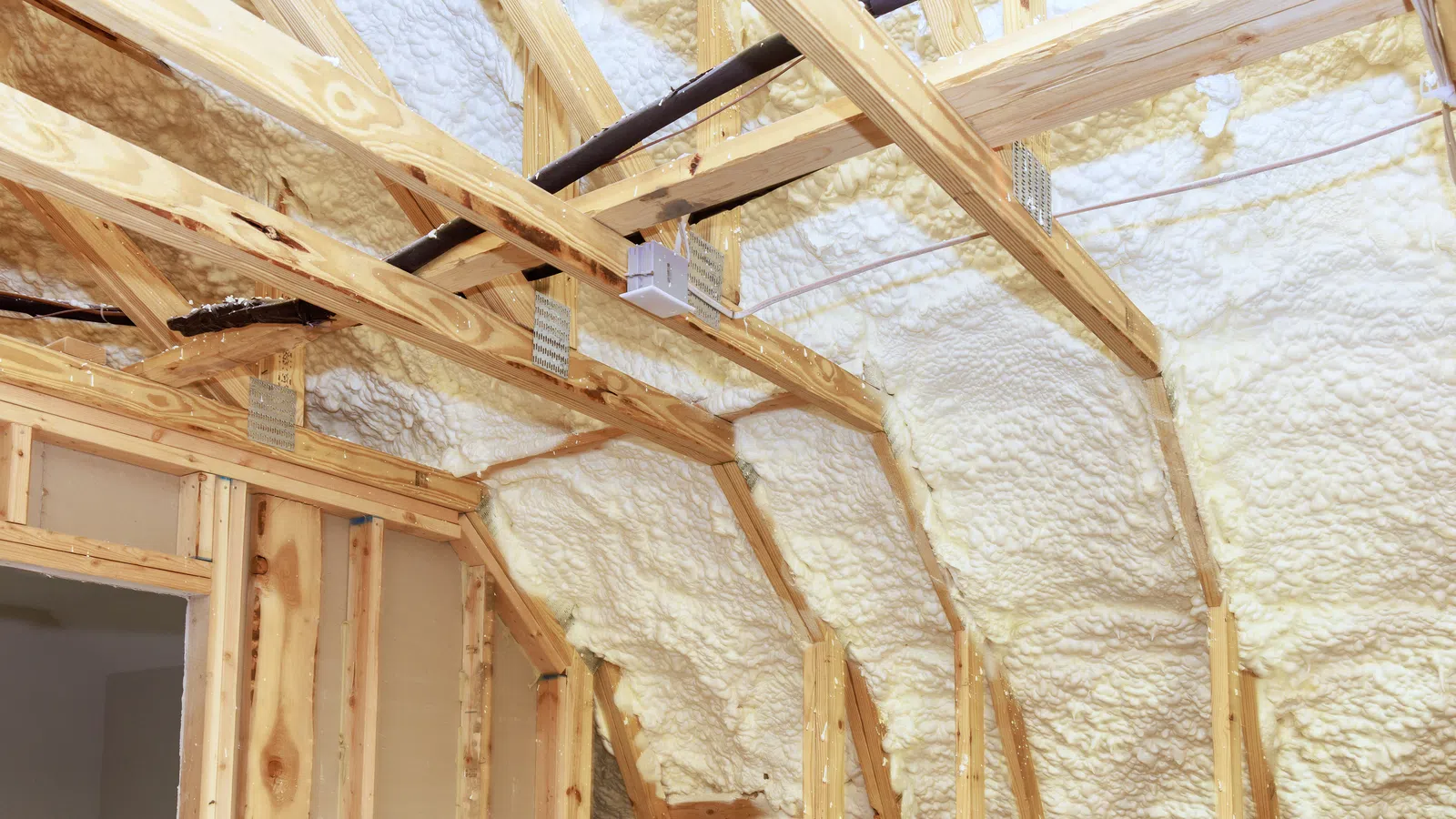
Insulation slows the movement of heat between your home and the outdoors. Heat always flows from warm to cold, so in winter it escapes and in summer it pushes in. Insulation resists that flow (measured as R-value), while air sealing stops leaks that carry heat directly. Together they keep indoor temperatures stable and lower energy use.
Why does it help to understand this before you get a quote?
Because the homeowner who knows how heat moves asks better questions, and better questions get better quotes.
Most of us never think about insulation until a room is freezing in January or the Avista Utilities bill jumps. If you understand the basics, you can tell the difference between someone who is solving your actual problem and someone who is just selling depth.
Which way does heat actually move in your house?
Heat always moves from warmer to cooler, and it keeps moving until the temperatures even out. The U.S. Department of Energy describes three ways it travels: conduction, convection, and radiation.
In a Spokane winter, your 68 degree living room is the warm side and the 20 degree night outside is the cool side, so heat is constantly working its way out. In July the direction flips, and outdoor heat pushes in toward your cooler rooms.
|
How heat moves |
What it means |
Where you feel it at home |
What slows it down |
|
Conduction |
Heat passing through solid materials, like a spoon handle warming up in hot coffee |
A cold exterior wall you can feel with your palm |
Insulation |
|
Convection (air movement) |
Warm air rising and cool air sinking, and air carrying heat through gaps |
Drafts near outlets, baseboards, and the attic hatch |
Air sealing |
|
Radiation |
Heat traveling in a straight line and warming whatever absorbs it |
A hot upstairs after the sun bakes the roof all afternoon |
Insulation depth and reflective barriers |
Most heat loss in an older home is a mix of the first two. That is why the fix is almost always a mix of two things as well.
What does R-value actually tell you?
R-value is resistance to heat flow. The DOE defines it as a material's resistance to conductive heat flow, and the higher the number, the better the material insulates.
Think of it as a speed bump for heat. More resistance means heat takes longer to get through, so your furnace runs less. R-value also adds up across layers.
What R-value does not measure is air movement. A thick layer of loose insulation can still let air drift right through it, which is where the next section comes in.
If you want the actual numbers for our area, we cover them in What R-Value Do You Need in Spokane and North Idaho? This post sticks to how it all works.
Why isn't insulation alone enough?
Because insulation slows heat, but it does not stop air. The DOE's air sealing guide puts it plainly: insulation does not necessarily block the movement of air.
Here is an easy way to picture it. Insulation is a wool sweater. It keeps you warm on a still day. Air sealing is a windbreaker. On a windy day, the sweater alone lets the cold cut right through you. Wear both and you stay warm.
Your house works the same way. Air leaking through gaps carries heat out directly, skipping right past your insulation. So a good job usually seals the gaps first and then adds insulation over them.
It pays off, too. ENERGY STAR estimates homeowners save an average of 15 percent on heating and cooling costs by air sealing and adding insulation. Your own result depends on your house, and we dig into that in [How Much Can New Insulation Really Lower Your Bill?]
What is the building envelope?
The building envelope is everything that separates heated, lived-in space from the outdoors and from unheated spaces like the attic, crawl space, or garage. Insulation and air sealing both belong on that boundary.
The parts that matter most:
- The attic floor. In most homes the heated space ends at the ceiling, not the roof. The insulation belongs on the attic floor, and the gaps around light fixtures, vent pipes, wiring, and the attic hatch need sealing.
- Exterior walls. The walls between your rooms and the outdoors. In many older homes these cavities hold little or nothing.
- Rim joists. The band of framing that sits on top of the foundation, where the floor meets the outside wall. It is often bare, and it leaks more than people expect.
- Floors over crawl spaces and garages. A floor over a cold crawl space or an unheated garage is part of the envelope, which is why the room above a garage is often the coldest in the house.
- Windows, doors, and penetrations. Anywhere a pipe, wire, duct, or chimney passes through the envelope, there is usually a gap.
An envelope is only as good as its weakest spot. A thick attic will not fix a room over an uninsulated garage.
What is the stack effect, and why does it matter in a Spokane winter?
The stack effect is your house acting like a chimney. Warm air rises and escapes through gaps near the top of the house, mostly into the attic. As it leaves, cold outdoor air gets pulled in through gaps near the bottom, like the rim joist, crawl space, and around doors.
The bigger the temperature difference between inside and outside, the harder that chimney pulls. That is why it is strongest on the coldest Spokane Valley and Coeur d'Alene nights, exactly when you are paying the most for heat. The DOE calls out this attic-to-living-space exchange as a common source of air leaks.
It explains cold floors downstairs and drafts along baseboards. Sealing the attic floor and the rim joist slows the chimney from both ends.
Why do older Inland Northwest homes leak so much?
A lot of homes here were built before energy codes asked much of them. Drive through the South Hill, Shadle, Garland, or West Central and you will see beautiful older houses that went up when heat was cheap and nobody was measuring air leaks.
Many have walls with little or no insulation, attic insulation that has settled for decades, and framing that has shifted enough to open gaps. Older neighborhoods in Coeur d'Alene and Post Falls share the same story.
Newer homes in Liberty Lake or Hayden are generally tighter, but "newer" is not the same as "sealed." Recessed lights, attic hatches, and rim joists can leak in any house.
What should you ask before you call?
Knowing how heat moves lets you ask questions that separate a real assessment from a quick sales visit. Here are the ones worth asking:
- Will you look at the whole envelope, or only the attic? A good assessment checks the attic, walls, rim joists, and floors over unheated space.
- How will you find the air leaks? Ask what they check and whether air sealing is part of the scope.
- Do you seal before you insulate? Sealing the attic floor first is what makes new insulation perform.
- How much insulation do I have now, and how will you document it? You want before and after measurements, ideally with photos.
- What is the priority order for my house? An honest answer tells you what to do first, not just one big number.
- Can you insulate my existing walls without tearing out drywall? For finished older homes, injection foam fills wall cavities through small access holes.
- Are you an Avista Utilities approved installer? Rebate eligibility depends on it. We explain the program requirements in our post on Avista Utilities rebate requirements.
Write the answers down. Comparing quotes is much easier when everyone answered the same questions.
How does it all come together?
Heat is always trying to move from warm to cold. Insulation slows it through the walls, ceiling, and floors. Air sealing stops it from riding out on leaking air. The building envelope is where both jobs happen, and the stack effect is why the attic and the rim joist matter so much in our winters.
Once you know that, a quote stops being a mystery.
Frequently Asked Questions
How does home insulation actually work? Insulation slows the movement of heat between your home and the outdoors. Heat always flows from warm to cold, so it escapes in winter and pushes in during summer. Insulation resists that flow, measured as R-value, while air sealing stops leaks that carry heat out directly.
What is the difference between air sealing and insulation? Insulation slows heat moving through walls, ceilings, and floors. Air sealing closes the gaps that let air, and the heat it carries, leak in and out. Insulation does not block air on its own, so the two work best together, with sealing done first.
What is the building envelope of a house? It is the boundary between your heated living space and the outdoors or unheated areas. That includes the attic floor, exterior walls, rim joists, floors over crawl spaces and garages, and every window, door, and penetration through them.
Does insulation help in summer too? Yes. Heat flows from warm to cool in any season. In summer the outdoors is the warm side, so the same insulation and air sealing that hold heat in during winter help keep it out of your rooms in July and August.
Why is my house still drafty after adding attic insulation? Usually because the air leaks were never sealed. Insulation slows heat but does not stop moving air, and the stack effect keeps pulling cold air in through low gaps like the rim joist. Sealing those gaps is often the missing step.
Ready to talk specifics?
Now that you know how it works, let us show you what is happening in your house. A free in-home assessment measures what you have, checks the whole envelope for leaks, and gives you a clear priority order. Get a free quote or call.